
AI GOVERNANCE
AI accountability &
decision governance
architecture
AI-supported decisions, executive judgement, governance-body oversight, fiduciary duty, escalation and documented responsibility: one integrated architecture for ensuring that accountability remains human, explicit and enforceable across the enterprise.

AI may inform analysis, generate options and support recommendations, but it cannot assume responsibility for decisions or their consequences. Material choices still require human judgement, contextual understanding and the authority to accept, reject or challenge an output. Effective governance therefore makes clear which decisions may be AI-supported, where human approval is mandatory and who remains accountable for the outcome. The objective is to prevent automation from obscuring ownership at the very point where responsibility matters most.
Human Accountability
Leadership, boards, committees and designated control functions retain fiduciary and governance obligations even when AI contributes to the decision process. These duties include acting with due care, understanding material risks, ensuring lawful and ethical conduct and maintaining appropriate oversight over systems that may affect customers, employees, financial reporting, operations or regulated activity. Governance must therefore define who has authority to approve AI-supported decisions, who reviews their use and when escalation to senior leadership or governance bodies is required.
Fiduciary & Governance Duty
Accountability becomes ineffective when decisions cannot be reconstructed or challenged. Organisations need documented records of who used AI, what role it played, which evidence supported the decision, which controls were applied and who accepted the resulting risk. Where outputs are uncertain, high-impact or inconsistent with policy, defined escalation pathways must ensure timely review by accountable individuals or governance bodies. This creates an auditable chain of responsibility rather than an untraceable dependency on automated outputs.
Traceability & Escalation
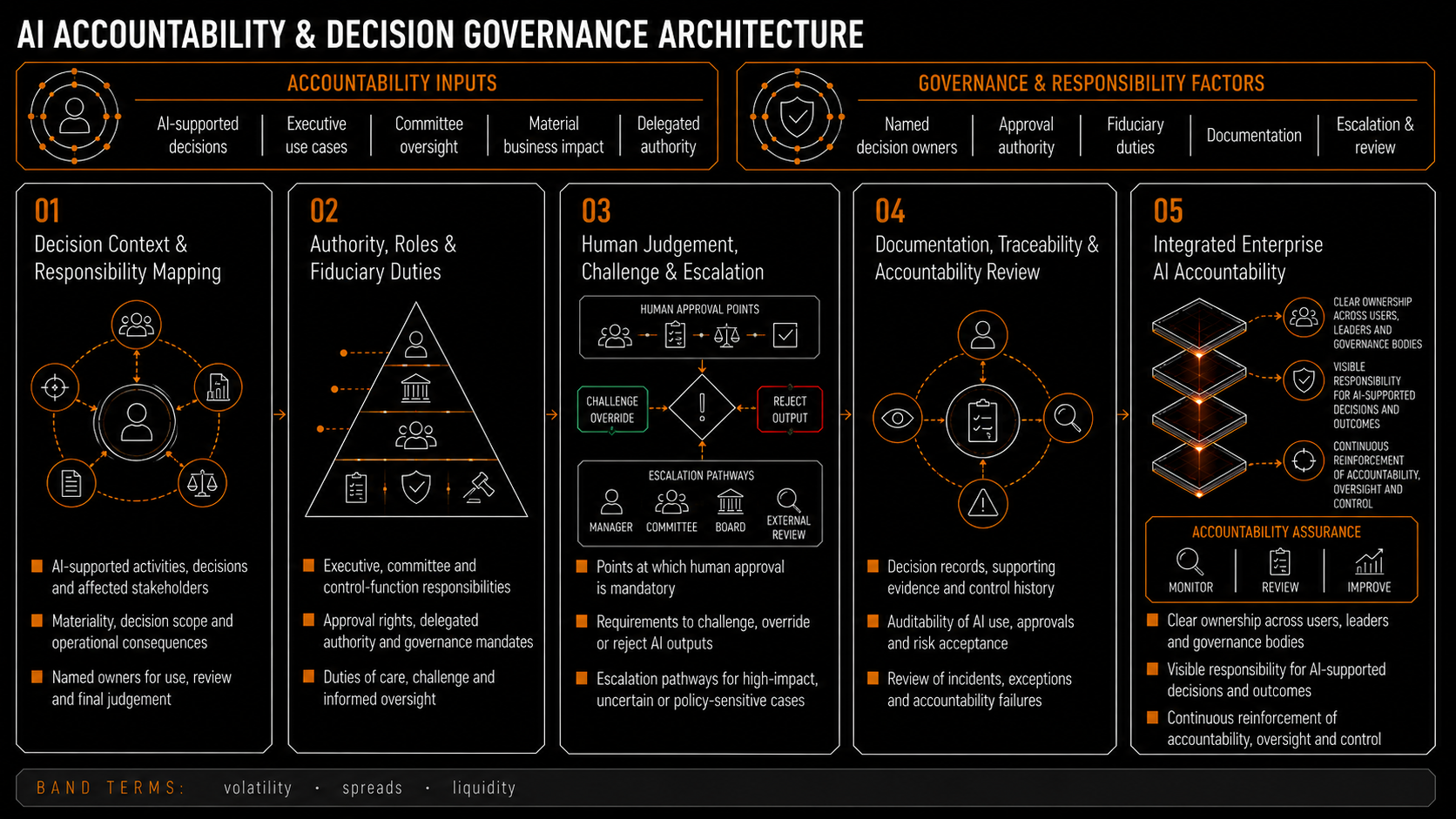
Accountability cannot be automated because responsibility for enterprise decisions remains with people, not systems. AI may accelerate analysis or structure recommendations, but it does not carry fiduciary duties, exercise judgement in the organisational sense or answer for legal, operational, financial or reputational consequences. Effective accountability architecture therefore connects decision context, named ownership, delegated authority, human approval, challenge rights, escalation pathways, documentation and governance review within one coherent structure. This ensures that AI-supported activity does not weaken responsibility by diffusing ownership, but instead operates within a framework where accountability remains explicit, traceable and enforceable.
© 2026 Coastlight Global Risk
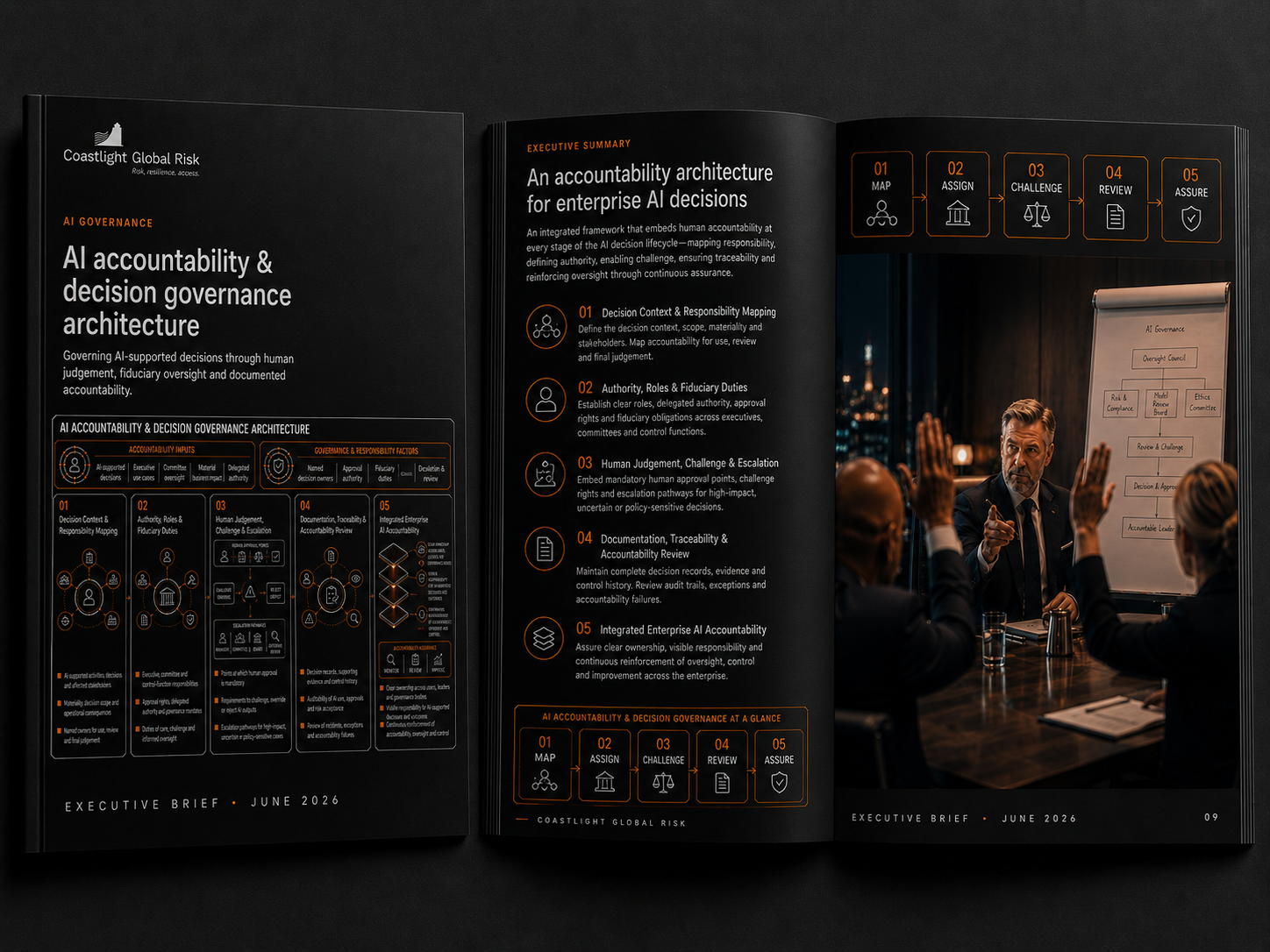
AI accountability & decision governance architecture
COASTLIGHT EXECUTIVE BRIEF
decision ownership, delegated authority and fiduciary responsibility
human review, challenge rights and escalation pathways
documentation, traceability and accountability assurance
How AI-supported decisions are governed through named ownership, fiduciary oversight, human judgement, escalation and documented accountability.