
AI adoption & exposure
architecture
AI GOVERNANCE

Employee adoption, shadow AI, embedded vendor capabilities, enterprise platforms, sensitive data and operational decision-making: one integrated architecture for identifying where AI already exists, how exposure is created and where governance must intervene.
AI adoption rarely begins through one coordinated enterprise programme. Employees introduce public tools, departments procure specialised applications, software providers embed AI into existing platforms and operational systems acquire automated capabilities through routine upgrades. The result is a distributed environment in which AI may already influence analysis, communication, customer interaction, production, recruitment, finance and management decisions before central governance has established complete visibility.
Adoption Reality
AI exposure arises through the interaction of technology, data, people and business processes. Sensitive information may enter external models, generated content may be relied upon without validation and third-party systems may introduce opaque models, training practices or contractual dependencies. Exposure also increases when AI affects customers, employees, safety, regulated activities, intellectual property or material operational decisions. Understanding these pathways requires more than an inventory of tools; it requires a view of how AI is actually used and what consequences may follow.
Exposure Pathways
Governance Integration
Governance must distinguish low-impact productivity use from applications capable of creating material legal, operational, financial or reputational consequences. Effective oversight establishes ownership, approved-use boundaries, risk classification, data requirements, human review, supplier controls and escalation thresholds. The objective is not to suppress adoption, but to ensure that AI use becomes visible, accountable and proportionate to the exposure it creates.
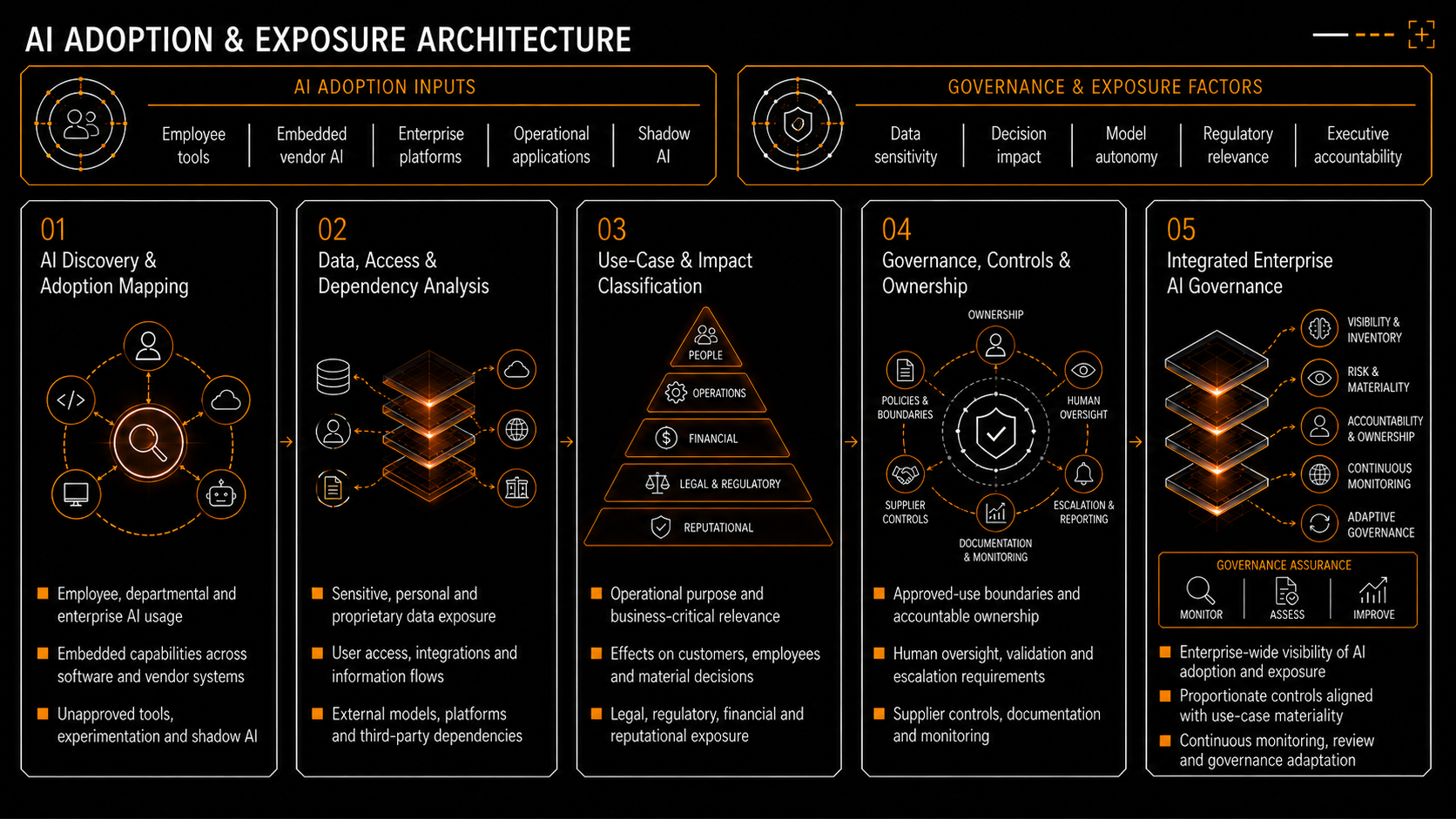
AI is entering organisations through employees, departments, software providers, enterprise platforms and operational systems simultaneously. A tool that appears to provide simple productivity support may still process sensitive information, influence a customer interaction, create intellectual-property exposure or become embedded within a material business decision. Effective AI governance therefore begins with visibility: where AI is being used, which data it can access, which processes depend on it and what level of autonomy or decision influence it possesses. An integrated adoption-and-exposure architecture connects discovery, data flows, third-party dependencies, use-case classification, human oversight, regulatory relevance, ownership and monitoring within one coherent enterprise view. This allows leadership to distinguish acceptable experimentation from material exposure and to govern AI adoption without losing control of its operational consequences.
© 2026 Coastlight Global Risk
COASTLIGHT EXECUTIVE BRIEF
AI adoption & exposure architecture

enterprise AI discovery, adoption mapping and shadow AI
data exposure, use-case materiality and third-party dependencies
governance controls, ownership and continuous oversight
How employee adoption, embedded vendor AI, enterprise platforms, data exposure and business impact are mapped to establish proportionate and accountable AI governance.