
AI deployment & validation architecture
AI GOVERNANCE

Use-case objectives, data access, model dependencies, legal exposure, operational impact and deployment readiness: one integrated architecture for transforming AI experimentation into a validated, controlled and enterprise-ready capability.
An AI initiative should not progress towards enterprise deployment merely because a pilot produces promising results. The use case must support a defined business objective, operate within a suitable process and create value that justifies its technical, operational and governance requirements. Effective assessment establishes who will use the capability, which decisions or activities it will influence, how performance will be measured and whether the initiative is sufficiently material to require formal enterprise oversight.
Enterprise Relevance
Enterprise readiness depends on validating more than model performance. Data quality, access rights, supplier dependencies, privacy, security, intellectual property, regulatory obligations, output reliability and human-review requirements must be examined together. Testing must reflect the environment in which the system will operate, including realistic users, workflows, failure conditions and potential downstream consequences. Validation determines whether the use case is appropriate, controlled and sufficiently reliable for its intended purpose.
Assessment & Validation
Moving from pilot to production changes the nature of the exposure. The AI capability becomes connected to enterprise data, systems, employees, customers, suppliers and operational processes. Controlled deployment therefore requires defined ownership, approval gates, access controls, monitoring, documentation, incident procedures, change management and rollback capability. The objective is to scale the use case without allowing experimentation to become an unmanaged operational dependency.
Controlled Deployment
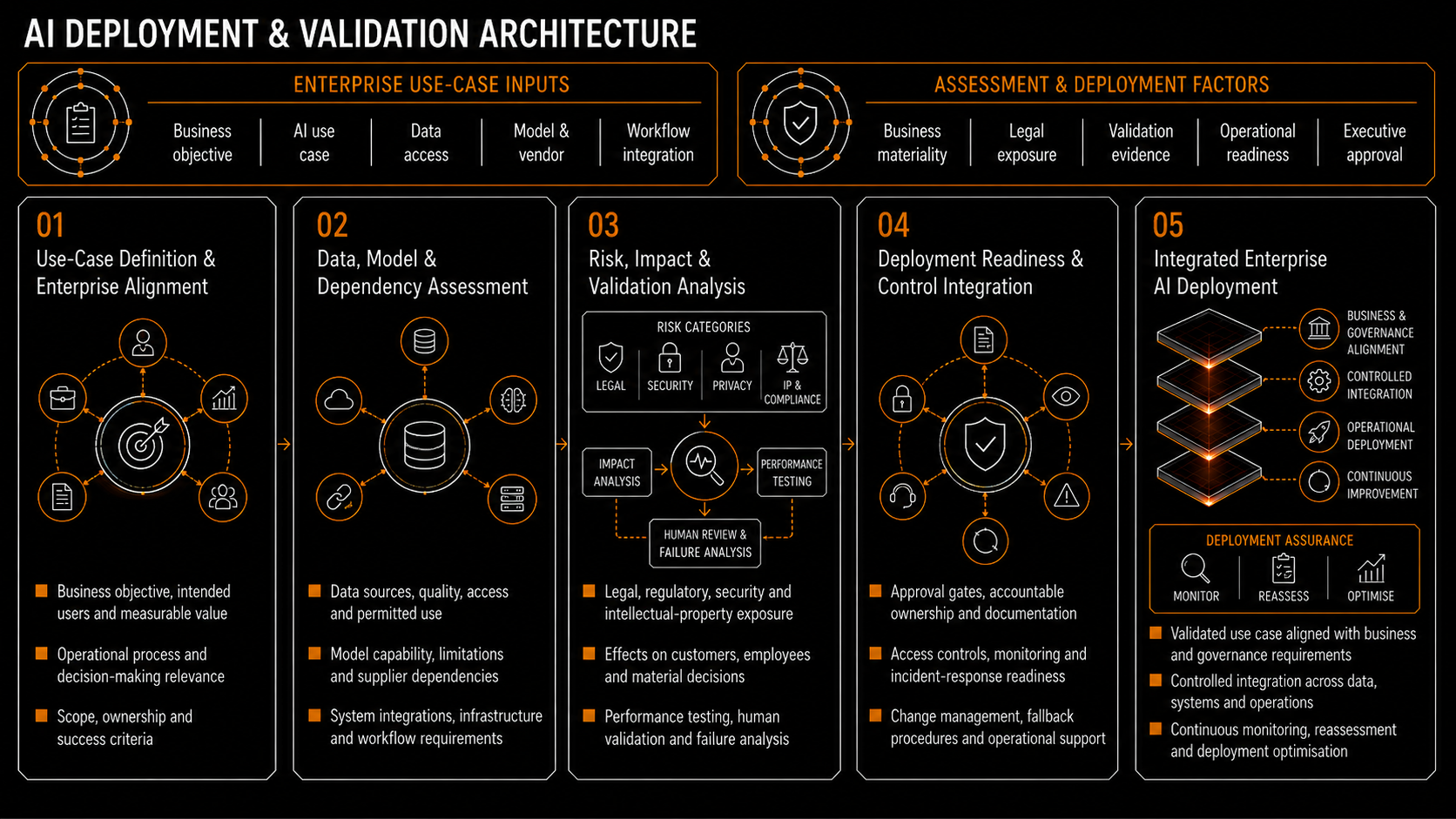
Moving an AI initiative from experiment to enterprise use requires more than technical success. A pilot may perform well within a limited environment while still depending on unsuitable data, an opaque external model, incomplete legal analysis or operational processes that are not prepared for deployment. Once integrated into the enterprise, the capability may influence employees, customers, production, financial decisions or regulated activities and become a material operational dependency. Effective deployment architecture therefore connects business relevance, data access, model and supplier assessment, legal exposure, validation evidence, human oversight, control readiness, operational integration and executive approval within one coherent structure. This allows the organisation to distinguish promising experimentation from genuinely enterprise-ready AI and to deploy capabilities only when their value, exposure and operating requirements are properly understood and controlled.
© 2026 Coastlight Global Risk
COASTLIGHT EXECUTIVE BRIEF
AI deployment & validation architecture
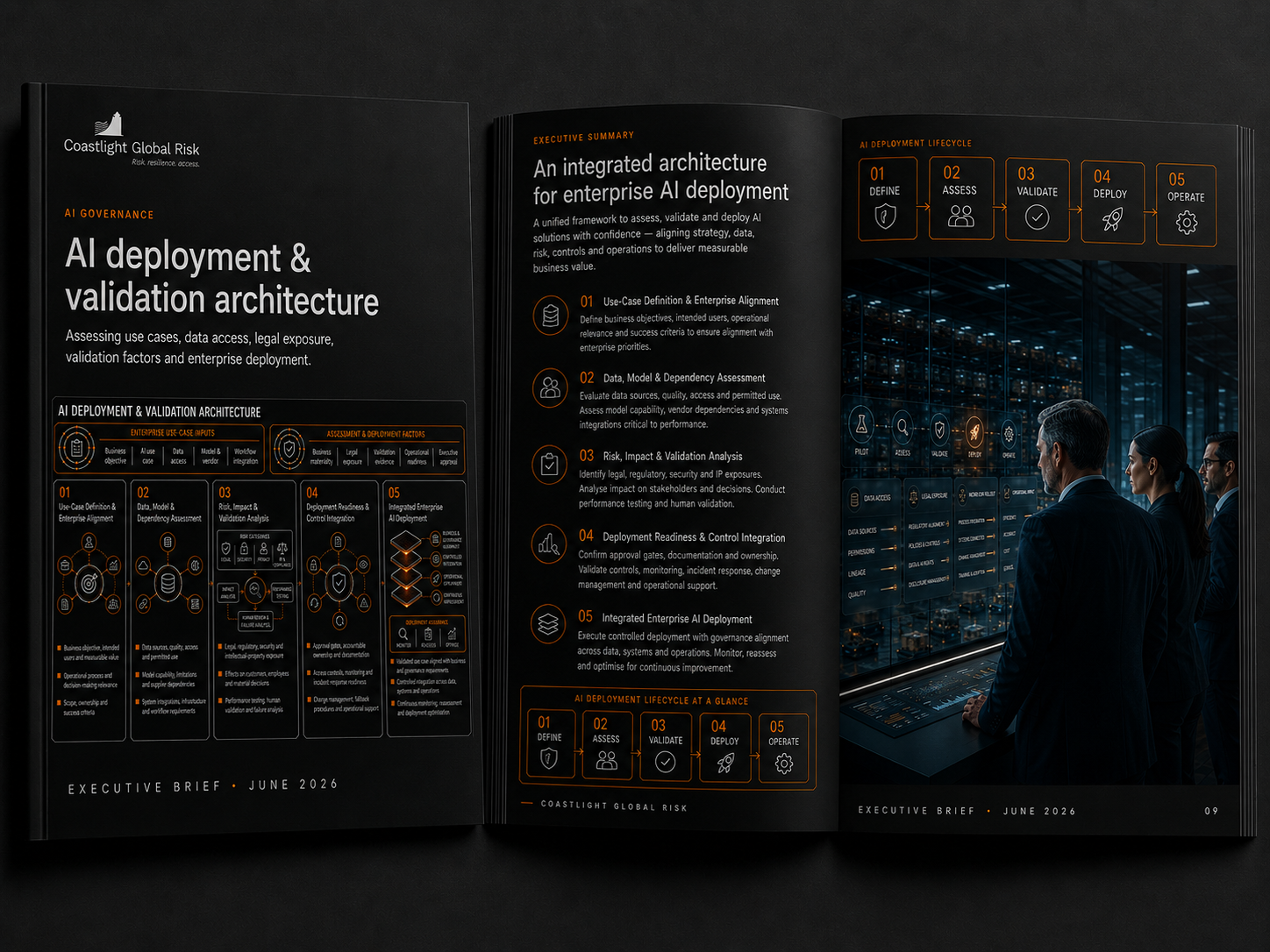
How AI use cases, data access, model dependencies, legal exposure and operational impact are assessed and validated before controlled enterprise deployment.
business relevance, use-case design and enterprise alignment
data, model, supplier and legal-risk assessment
validation, deployment controls and continuous oversight