
AI governance & oversight architecture
AI GOVERNANCE

Policies, roles, approval pathways, regulatory obligations, monitoring and executive accountability: one integrated architecture for transforming distributed AI adoption into a governed, compliant and accountable enterprise capability.
Effective AI governance begins by defining how the organisation intends to use AI, which activities are permitted and where restrictions or prohibitions are required. Policies must translate enterprise values, risk appetite, legal obligations, data standards and operational priorities into practical rules for employees, departments, suppliers and technology teams. Clear boundaries distinguish acceptable experimentation from uses requiring formal approval, enhanced controls or executive oversight.
Policy & Boundaries
Roles & Decision Rights
Governance cannot function when responsibility is distributed without clear authority. Business owners, technology teams, risk, compliance, legal, data protection, information security and executive leadership must understand their respective roles across the AI lifecycle. Decision rights must establish who may approve a use case, who validates compliance, who accepts residual risk and who can suspend or escalate an application when exposure exceeds agreed tolerances.
Governance remains effective only when implementation can be monitored and evidenced. Approved use cases, models, suppliers, data access, human-review requirements, incidents, control exceptions and material changes must be documented within a consistent oversight structure. Compliance monitoring, management reporting and independent assurance allow leadership to determine whether policy is being followed, whether controls remain effective and where intervention is required.
Oversight & Compliance
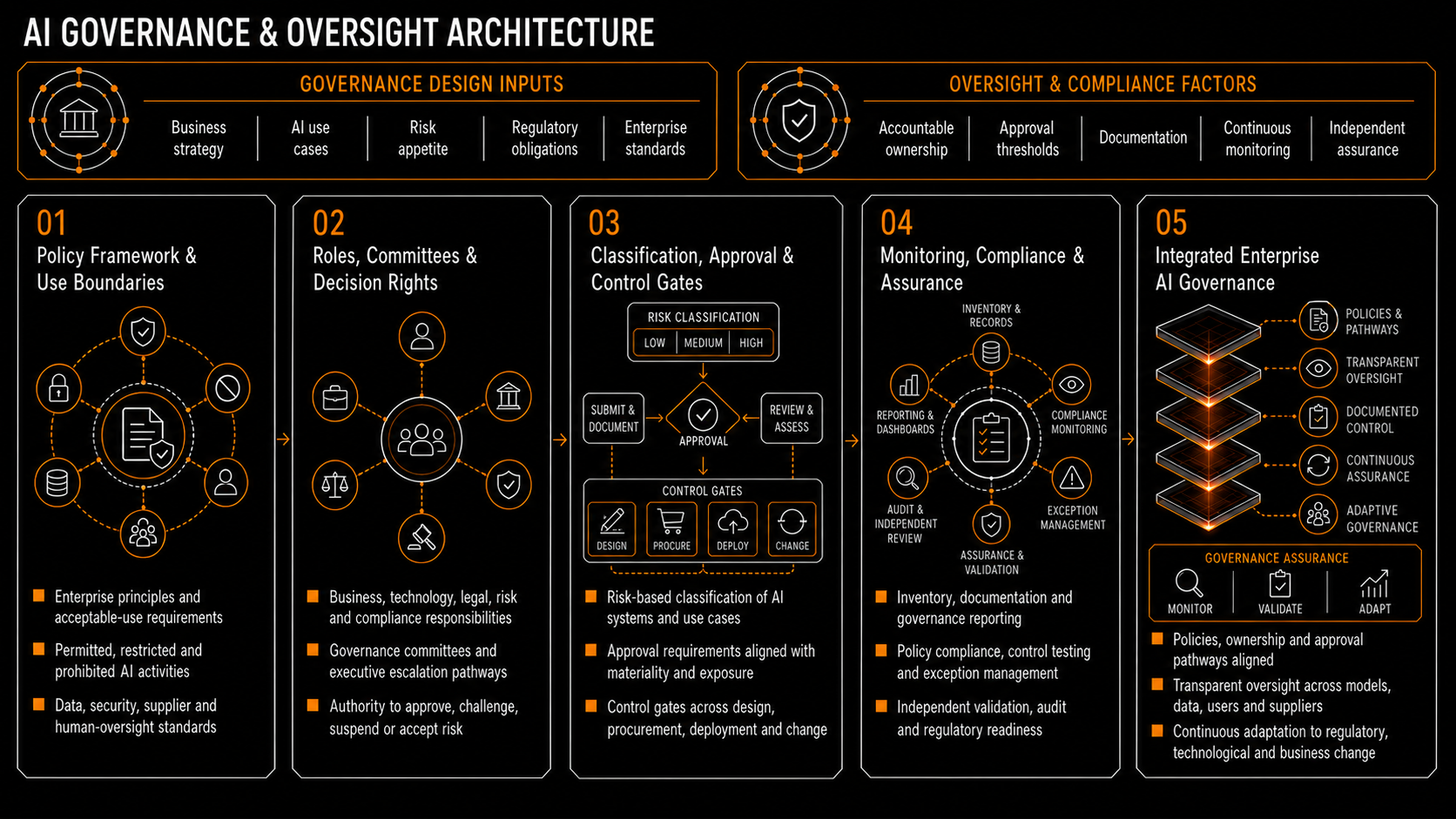
Governance creates control by converting principles into defined responsibilities, approval pathways, operating rules and verifiable oversight. Without this structure, AI adoption may continue through employees, departments, suppliers and embedded platforms without consistent standards or accountable ownership. Effective AI-governance architecture therefore connects enterprise strategy, risk appetite, policies, use-case classification, decision rights, control gates, documentation, monitoring, compliance and assurance within one coherent operating model. This allows the organisation to support responsible innovation while ensuring that material AI use is authorised, traceable, proportionately controlled and subject to meaningful executive oversight.
© 2026 Coastlight Global Risk
COASTLIGHT EXECUTIVE BRIEF
AI governance & oversight architecture

How policies, roles, approval pathways, compliance monitoring and executive accountability transform AI adoption into a governed enterprise capability.
AI policies, acceptable-use boundaries and enterprise standards
roles, decision rights, approval thresholds and control gates
oversight, compliance monitoring and independent assurance