
CYBER RESILIENCE
Continuous improvement
architecture

Incident lessons, exercise findings, control performance, threat evolution, remediation progress and resilience maturity: one integrated architecture for continuously calibrating and strengthening the organisation’s capacity to withstand, respond to and recover from cyber disruption.
Cyber resilience cannot be assessed through policies, technology investments or isolated control metrics alone. Leadership requires evidence of how controls, response structures, recovery capabilities and continuity measures perform in practice. Incidents, near misses, exercises, audit findings, recovery tests, control monitoring and operational feedback reveal where resilience is effective, where assumptions are no longer valid and where weaknesses remain unresolved.
Performance Evidence
Every incident, exercise and material change should improve the organisation’s future response. Effective learning distinguishes immediate symptoms from underlying causes, identifies failures in technology, process, ownership or decision-making and translates findings into specific corrective actions. Controls, thresholds, playbooks, recovery objectives and escalation pathways must then be recalibrated so that lessons produce measurable improvements rather than static reports.
Learning & Calibration
Adaptive Resilience
Threats, technologies, suppliers, business models and operational dependencies continue to evolve. Resilience must therefore adapt as the organisation changes. Continuous improvement connects remediation, assurance, exercising, threat intelligence, business transformation and executive oversight within an ongoing cycle of validation and optimisation. The objective is not a fixed state of readiness, but a resilience capability that remains relevant, tested and effective over time.
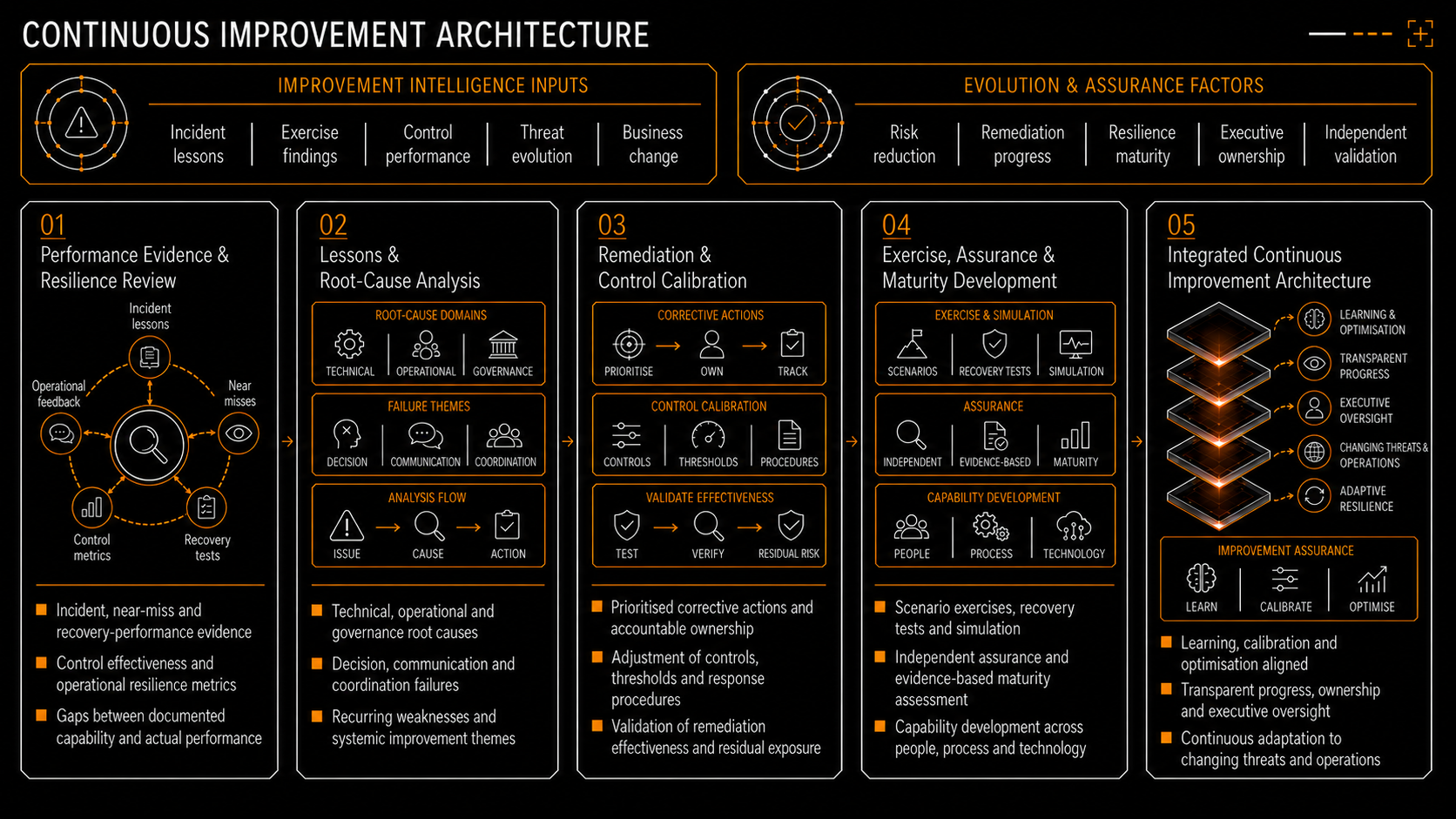
Cyber resilience is maintained through continuous evidence, learning and adaptation. Incidents, exercises, recovery tests, control monitoring and operational change continually reveal whether existing assumptions, response structures and continuity measures remain effective. Findings create value only when they are translated into prioritised remediation, accountable ownership, calibrated controls and verified improvement. Effective continuous-improvement architecture therefore connects performance evidence, root-cause analysis, threat evolution, business change, remediation progress, assurance and maturity development within one coherent cycle. The objective is to ensure that resilience does not gradually weaken as the organisation and threat environment evolve, but becomes more precise, tested and effective over time.
© 2026 Coastlight Global Risk
COASTLIGHT EXECUTIVE BRIEF
Continuous improvement architecture
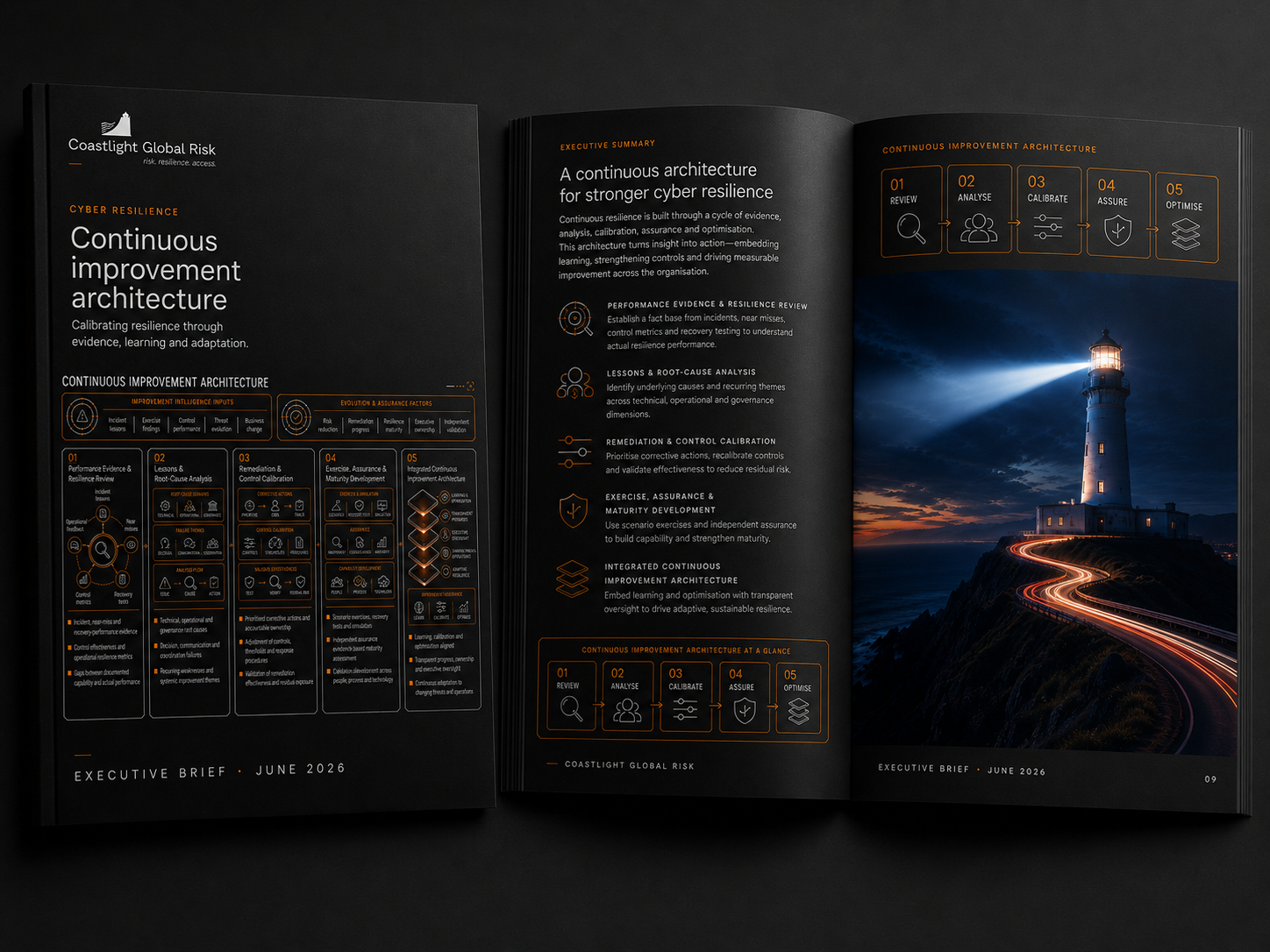
How incident lessons, exercise findings, control performance and threat evolution are translated into calibrated controls, verified remediation and stronger cyber resilience.
performance evidence, incident lessons and root-cause analysis
remediation, control calibration and resilience assurance
continuous evolution, maturity development and optimisation