
CYBER RESILIENCE
Critical dependency
architecture

Essential processes, digital linkages, third-party services, failure pathways and operational tolerances: one integrated architecture for identifying the business capabilities that cannot stop and the dependencies required to keep them running.
Not every process, application or supplier carries the same operational importance. Critical-dependency analysis begins by identifying the products, services, production activities, customer commitments and safety functions whose interruption would create unacceptable operational, financial, regulatory or reputational consequences. The objective is to establish which business capabilities are genuinely vital and how long each can remain unavailable before disruption becomes material.
Business Criticality
Dependency Pathways
Critical operations rarely depend on one system or provider in isolation. Applications, data, identities, networks, cloud platforms, equipment, utilities, specialist personnel and third parties form interconnected pathways that support delivery. Mapping these linkages reveals how failure may propagate across functions, locations and supply chains, where hidden dependencies exist and where several critical services rely on the same underlying component.
Resilience weakens when multiple vital processes depend on a single platform, provider, location, network route or specialist resource. Effective analysis evaluates concentration, substitutability, redundancy, recovery readiness and manual alternatives in order to distinguish manageable dependencies from single points of failure. The result is a prioritised view of where continuity measures, diversification, technical resilience or executive intervention are required.
Concentration & Continuity
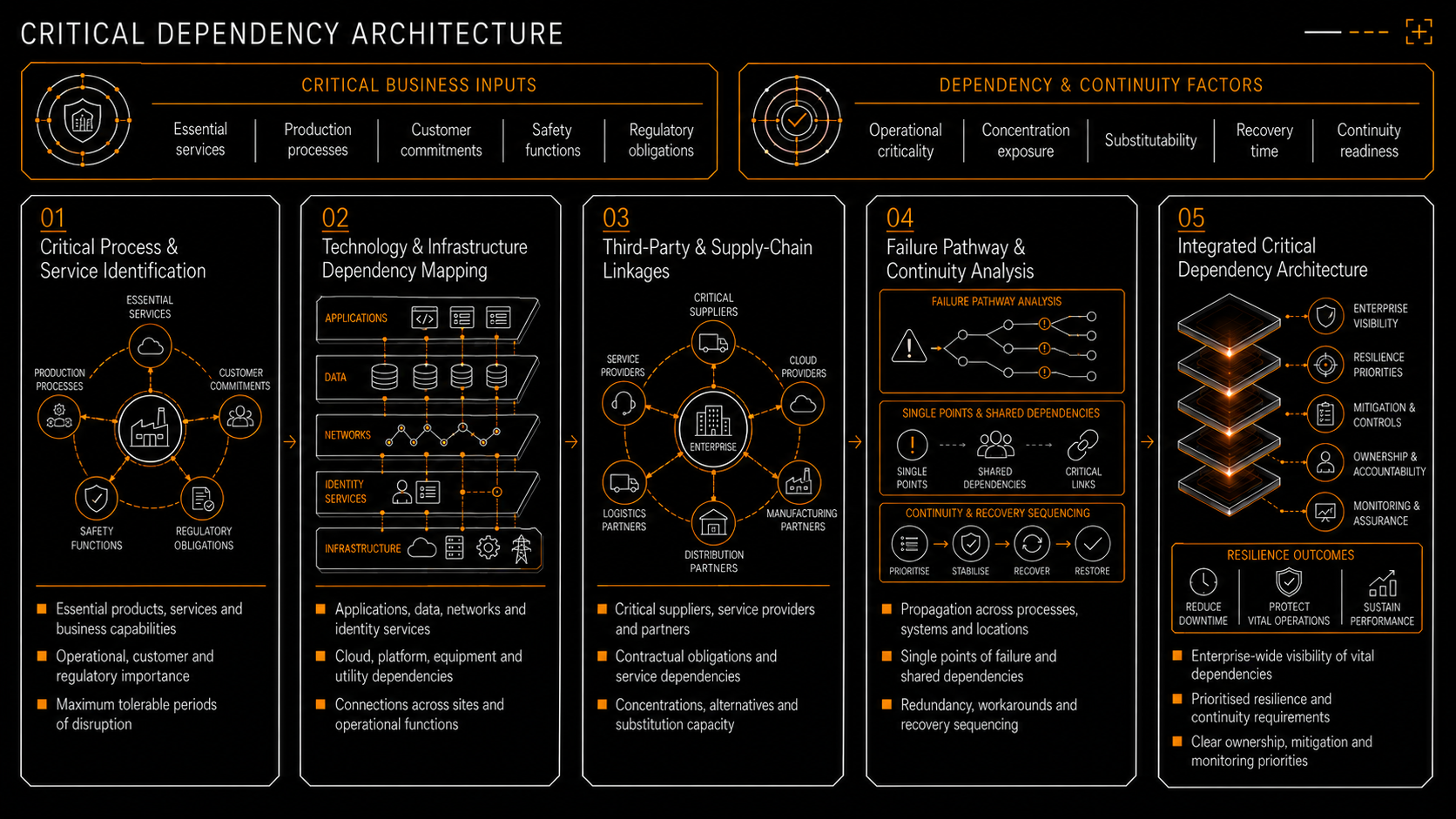
Critical business services are sustained by complex networks of technology, infrastructure, suppliers, data, people and operational resources. A process that appears resilient in isolation may still depend on one cloud platform, specialist provider, network connection, production asset or individual with no effective substitute. The failure of a single component may therefore interrupt several vital services and propagate across sites, customers and supply chains. Effective critical-dependency architecture connects business importance, dependency linkages, failure pathways, concentration exposure, operational tolerance, redundancy and recovery readiness within one coherent enterprise view. This allows leadership to identify which processes cannot stop, where continuity is most vulnerable and which dependencies require protection, diversification, preparation or immediate action.
© 2026 Coastlight Global Risk
COASTLIGHT EXECUTIVE BRIEF
Critical dependency architecture
critical services, operational tolerances and business vitals
technology, third-party linkages and failure pathways
concentration exposure, continuity readiness and executive action
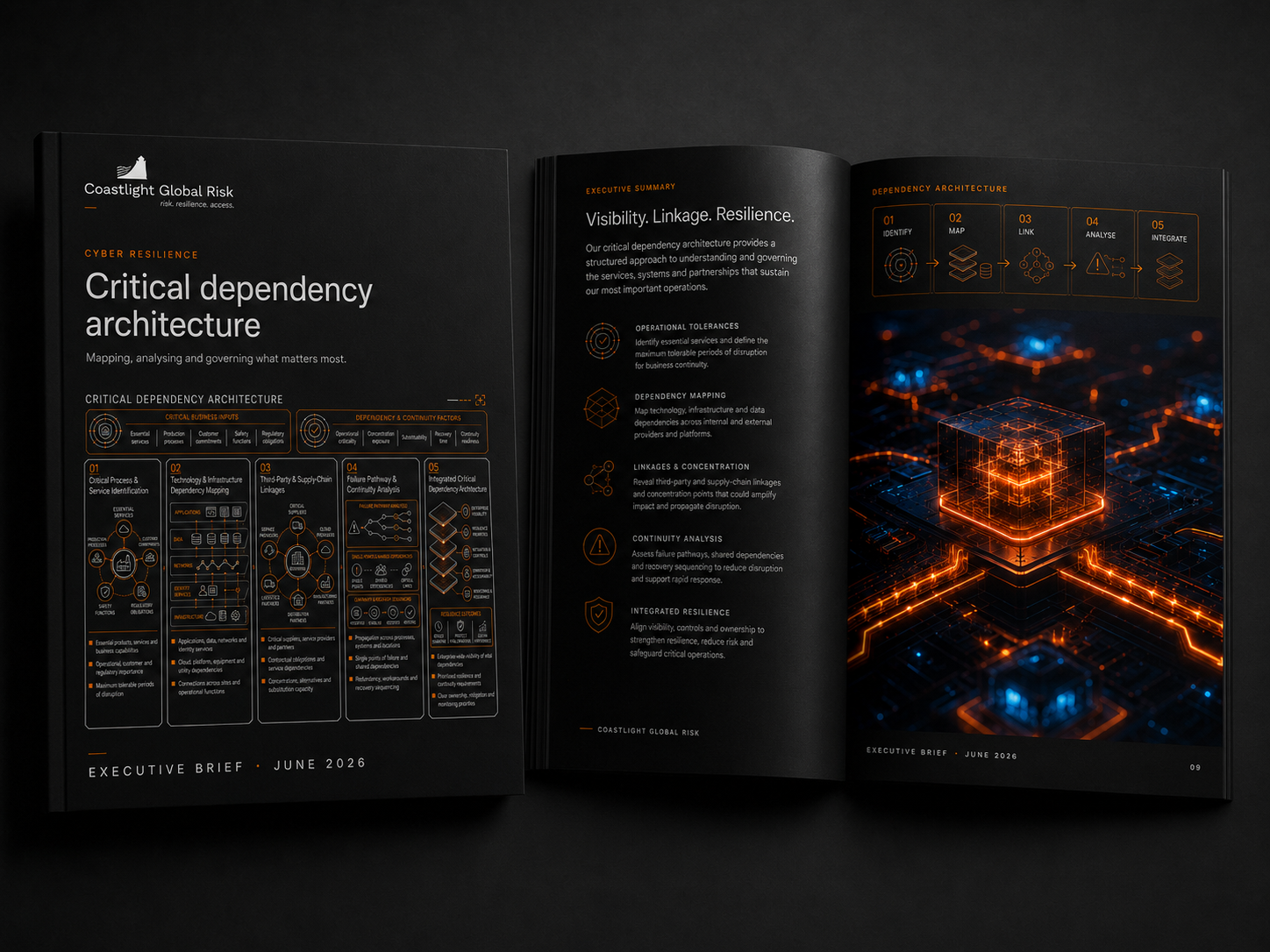
How essential processes, technology, infrastructure and third-party linkages are mapped to reveal failure pathways, concentration risks and continuity priorities.