
EXECUTIVE RISK ADVISORY
Decision
architecture

Material risk exposures, plausible scenarios, strategic options, operational constraints and executive trade-offs: one integrated architecture for turning uncertainty into decisions that leadership can evaluate, govern and act upon.
Effective decisions begin with a precise definition of what must actually be decided. A risk may affect operations, supply chains, customer delivery, contracts, liquidity, assets, reputation or strategic objectives simultaneously. Decision framing establishes the material exposure, the business functions affected, the time available, the relevant constraints and the consequences of action or inaction. This prevents leadership from responding to a broad risk description without first identifying the specific decision required.
Decision Framing
Scenario & Option Design
Uncertainty cannot be eliminated, but it can be structured. Decision architecture translates material exposures into plausible operating scenarios and develops corresponding strategic options. These may include mitigation, operational redundancy, supplier diversification, contractual intervention, risk transfer, contingency planning, capital allocation or deliberate risk retention. Each option must be assessed against the same assumptions, impact pathways and decision criteria.
No material decision is without cost, limitation or consequence. Leadership must compare risk reduction, implementation time, operational feasibility, financial commitment, reversibility, insurance response and strategic impact. Effective decision architecture makes these trade-offs visible, establishes clear ownership and translates the preferred option into sequenced actions, decision gates and monitoring requirements.
Executive Trade-offs
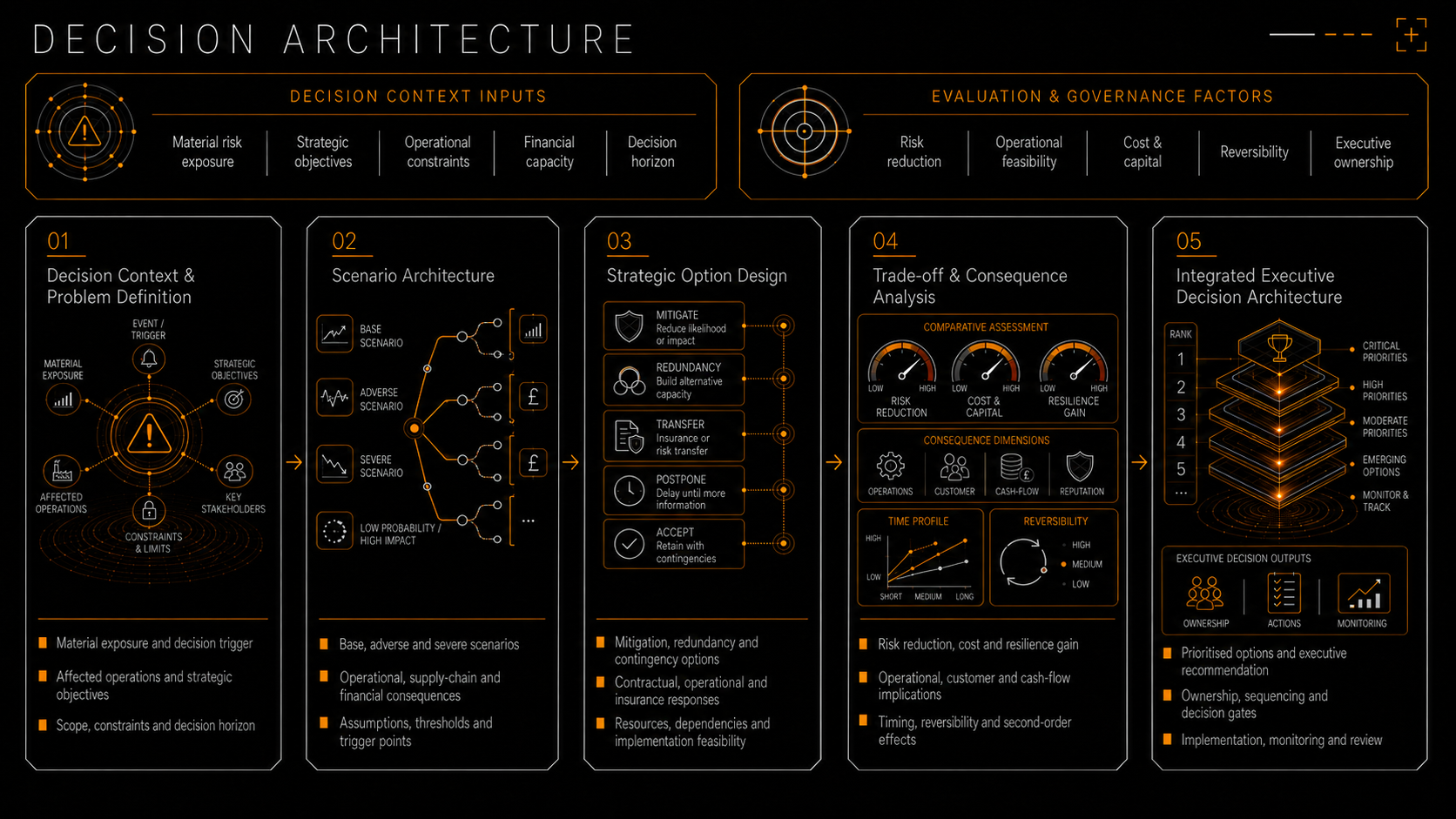
Decision architecture converts complex risk exposure into a structured set of choices. A material disruption may require leadership to balance continuity of operations, customer obligations, supplier relationships, contractual rights, insurance recovery, liquidity protection and long-term strategic positioning. These considerations cannot be evaluated effectively through isolated risk indicators or a single forecast. They must be translated into plausible scenarios, comparable response options and explicit trade-offs. An integrated decision architecture therefore connects exposure, consequence, feasibility, cost, timing, ownership and reversibility so that leadership can understand not only which option appears preferable, but why it is preferable, what it requires and how it should be implemented.
© 2026 Coastlight Global Risk
COASTLIGHT EXECUTIVE BRIEF
Decision architecture
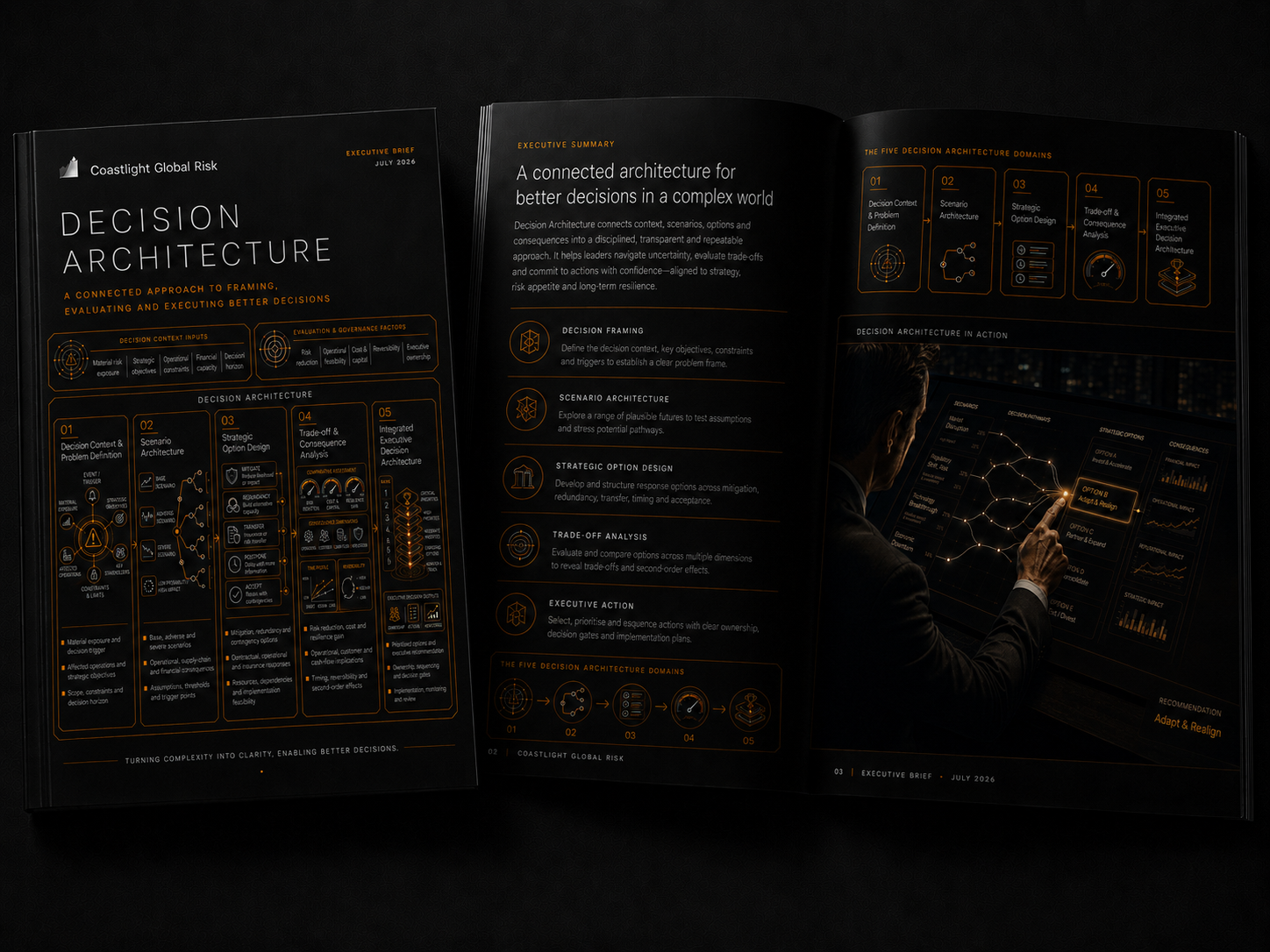
How material risk exposures are translated into scenarios, strategic options, executive trade-offs and structured pathways for action.
decision framing and scenario architecture
strategic options, trade-offs and consequence analysis
executive ownership, sequencing and implementation