
MACRO INTELLIGENCE
Financial-system stress & enterprise transmission
Interbank volatility, credit-spread expansion, equity-market dislocation, collateral pressure and sudden liquidity contraction: one integrated framework for understanding how financial stress propagates through markets and reaches enterprise assets, financing, resilience and risk-transfer capacity.

Financial stress rarely remains confined to the market in which it first appears. A repricing of interest-rate expectations, a banking concern, a sovereign shock or a sudden change in investor confidence can increase volatility across equities, credit, currencies and funding markets simultaneously. Correlations may rise precisely when diversification is expected to provide protection, while market depth can disappear as participants reduce exposure. Effective macro intelligence therefore identifies changes in the stress regime before they become visible through conventional corporate indicators.
Volatility & Market Stress
Stress moves through the financial system by changing the price and availability of liquidity. Interbank funding costs may rise, credit spreads may widen, lenders may tighten standards and investors may demand greater compensation for uncertainty. Collateral requirements, margin calls and refinancing constraints can amplify the initial shock as institutions sell assets or withdraw capacity. Understanding transmission requires connecting money markets, bank funding, sovereign risk, corporate credit and market liquidity rather than analysing each channel in isolation.
Credit & Liquidity Transmission
Enterprise Exposure & Resilience
Financial-market disruption reaches the enterprise through financing costs, asset values, pension obligations, counterparty strength, working capital and the availability of external risk-transfer capacity. Even a company with limited direct market activity may be exposed through banks, insurers, suppliers, customers or investment portfolios. Effective analysis determines which financial channels matter most, how rapidly stress may affect operations and whether liquidity, capital and risk-transfer arrangements remain sufficient under deteriorating conditions.
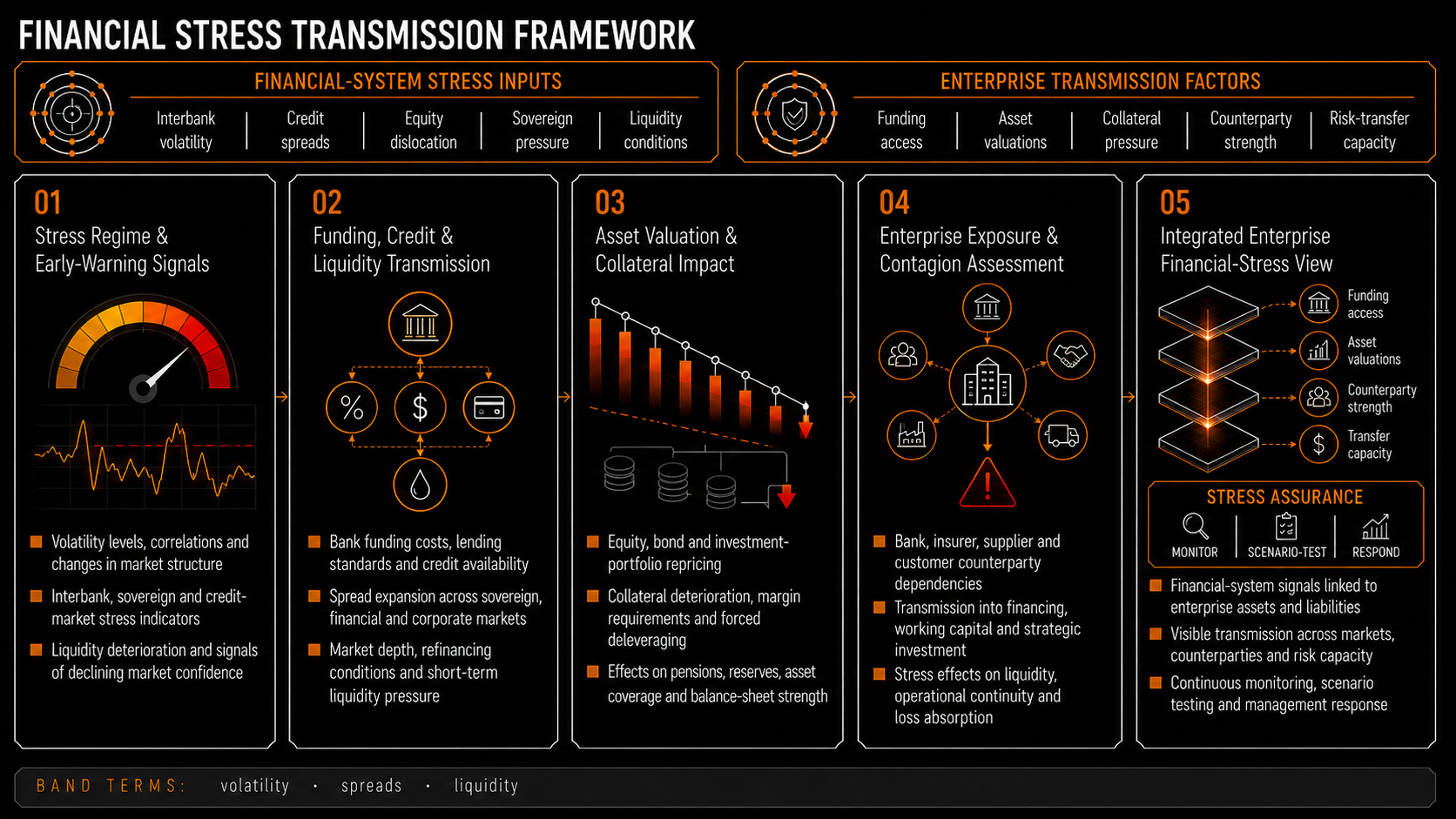
Stress travels through the financial system because markets, banks, sovereigns, investors and corporate balance sheets are connected through funding, collateral, confidence and liquidity. An initial shock may begin as interbank volatility, widening credit spreads or an equity-market correction, but its consequences can expand rapidly as financing becomes more expensive, asset values decline and institutions reduce exposure. Enterprises may then experience tighter credit, weaker counterparties, refinancing pressure, pension or investment losses and reduced insurance or risk-transfer capacity before any direct operational disruption becomes visible. Effective macro analysis connects early-warning indicators, funding markets, credit transmission, asset valuations, collateral pressure, counterparty exposure and enterprise liquidity within one coherent stress framework. This enables leadership to identify how systemic pressure could reach the organisation and to act before market stress becomes a balance-sheet or operational constraint.
© 2026 Coastlight Global Risk
COASTLIGHT EXECUTIVE BRIEF
Financial-system stress & enterprise transmission
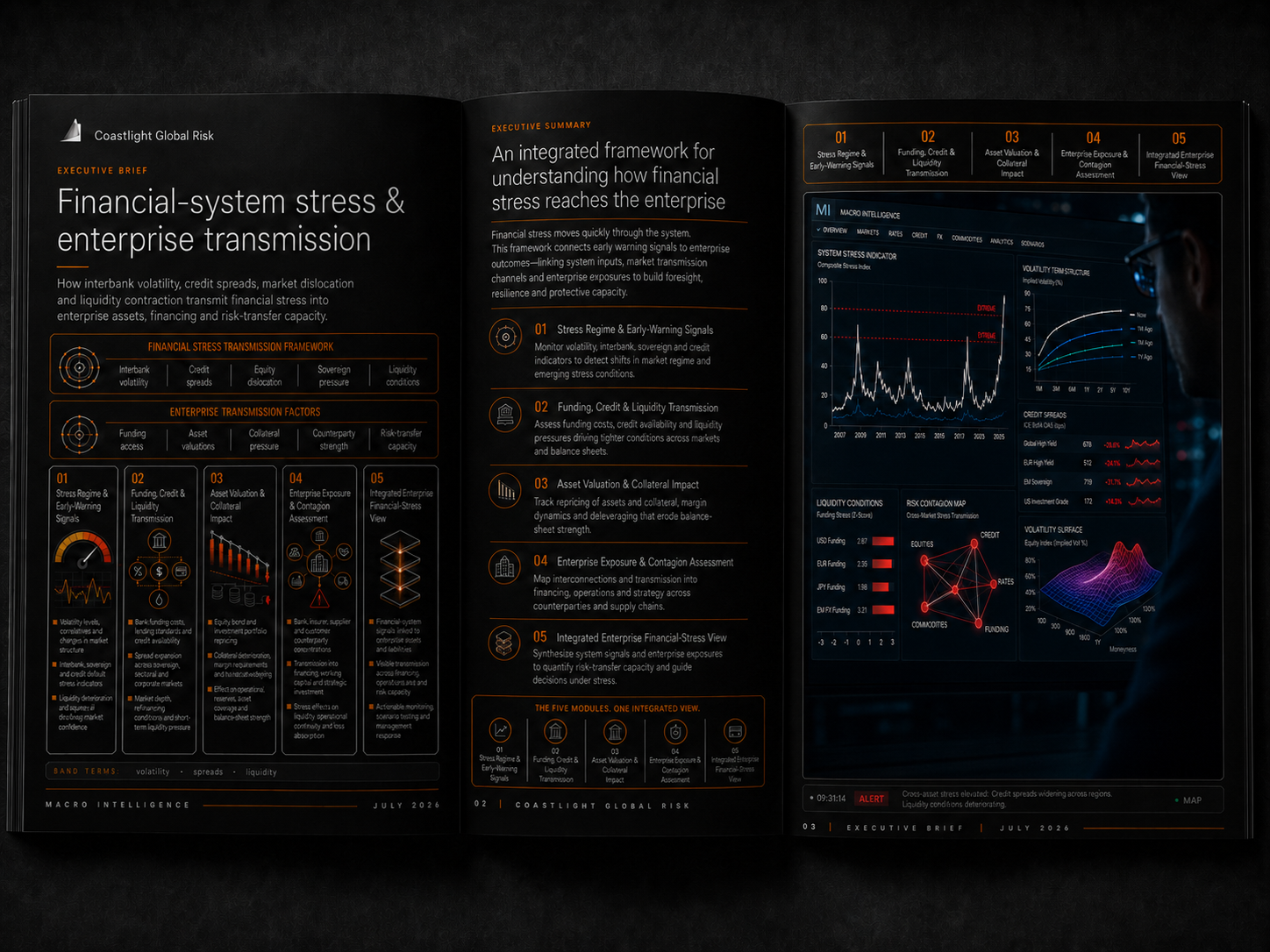
volatility regimes, credit spreads and financial-system warning signals
funding transmission, asset repricing and counterparty exposure
enterprise liquidity, resilience and risk-transfer capacity
How interbank volatility, credit spreads, market dislocation and liquidity contraction transmit financial stress into enterprise assets, financing and risk-transfer capacity.