
MACRO INTELLIGENCE
Input volatility &
enterprise transmission
Energy benchmarks, raw-material prices, industrial inputs, supplier contracts, production dependencies and risk-transfer conditions: one integrated framework for understanding how commodity volatility moves through the enterprise and reshapes costs, margins, continuity and financial resilience.

Input volatility begins in markets but does not remain there. Energy benchmarks, metals, agricultural commodities, chemicals and specialised industrial materials may reprice rapidly in response to geopolitical events, production constraints, inventory changes, currency movements or shifts in global demand. Headline prices alone do not reveal the full exposure. Effective macro intelligence distinguishes temporary market noise from sustained changes in the cost, availability and strategic importance of the inputs on which enterprise operations depend.
Commodity & Input Volatility
Market-price movements reach the organisation through procurement contracts, indexation clauses, supplier negotiations, energy agreements, logistics costs and replacement cycles. The speed and severity of transmission depend on contract duration, hedging arrangements, purchase frequency, supplier concentration and the organisation’s ability to pass higher costs to customers. Even where inputs remain physically available, volatility can weaken budgeting accuracy, compress margins and create working-capital pressure as inventories and supplier requirements become more expensive.
Cost & Contract Transmission
Operations, Margins & Risk Transfer
Input volatility becomes a material enterprise issue when it affects production continuity, product economics, customer commitments or the cost of protecting the organisation against loss. Higher energy and material prices may alter operating margins, asset replacement values, business-interruption exposure and insurance limits. Effective analysis connects commodity markets with procurement, production, pricing, liquidity and risk-transfer arrangements to determine where volatility can be absorbed and where it requires operational, financial or contractual intervention.
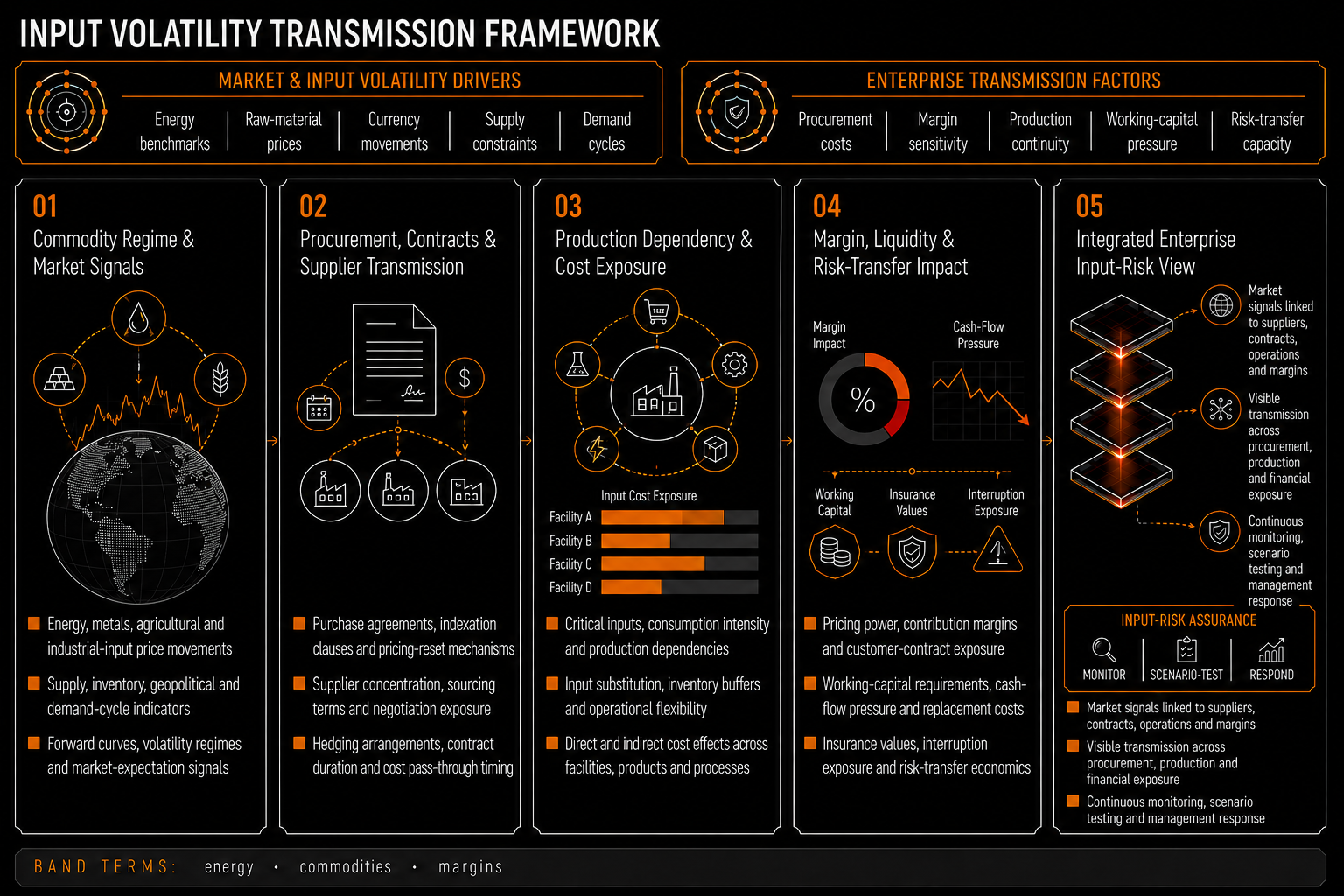
Input volatility moves through the enterprise because commodity prices are transmitted through contracts, suppliers, production processes, customer pricing and financial arrangements. A rise in energy, metals, chemicals or other critical inputs may initially appear as a market movement, yet quickly alter procurement costs, inventory requirements, operating margins and production economics. Contract structures, supplier concentration, limited substitution options and delayed customer pass-through can amplify the effect and convert price volatility into a material liquidity or continuity issue. Effective macro analysis therefore connects commodity signals, supplier terms, procurement exposure, production dependency, pricing power, working capital and risk-transfer conditions within one coherent transmission framework. This enables leadership to identify where input volatility can be absorbed, where it threatens enterprise resilience and which operational, contractual or financial responses are required.
© 2026 Coastlight Global Risk
COASTLIGHT EXECUTIVE BRIEF
Input volatility & enterprise transmission
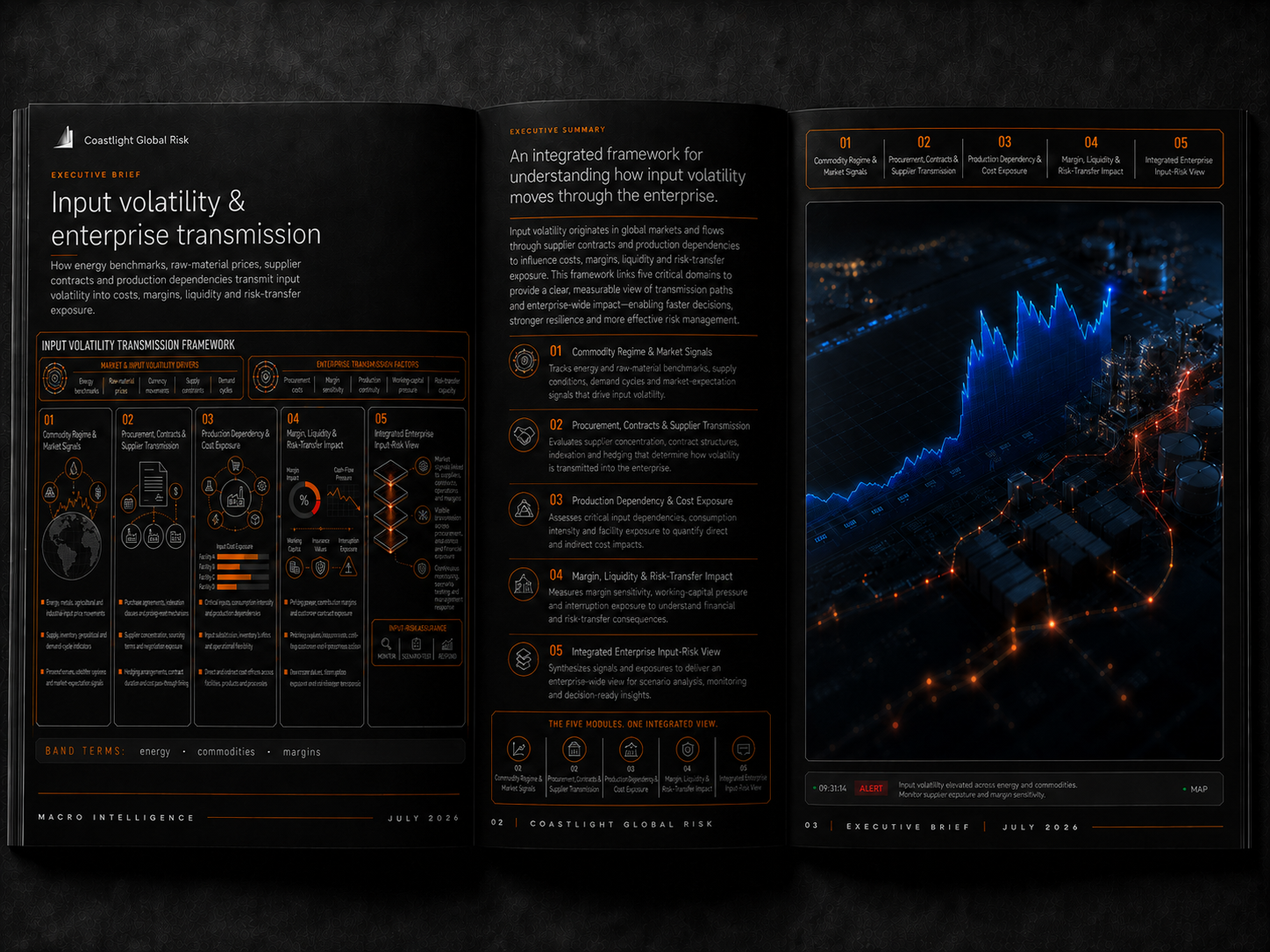
How energy benchmarks, raw-material prices, supplier contracts and production dependencies transmit input volatility into costs, margins, liquidity and risk-transfer exposure.
commodity regimes, supply constraints and market-price signals
procurement contracts, supplier dependencies and cost transmission
margin sensitivity, production continuity and risk-transfer capacity