
MACRO INTELLIGENCE
Interest rates &
the cost of risk

Policy rates, yield curves, liquidity conditions, refinancing pressure, sovereign valuations and risk-transfer capacity: one integrated framework for understanding how monetary conditions reshape corporate funding, balance-sheet resilience and the economic cost of risk across the enterprise.
Interest rates do not affect risk only through headline central-bank announcements. They move through yield curves, money markets, credit spreads, liquidity conditions and market expectations, changing the price of capital across the economy. A shift in the policy regime can alter borrowing costs, investor behaviour, asset allocation and the availability of financing long before its full impact is visible in the real economy. Effective macro analysis therefore tracks not only the level of rates, but also the transmission channels through which monetary policy changes financial conditions.
Monetary Transmission
Financing & Balance-Sheet Sensitivity
Higher or more volatile rates directly affect how companies finance operations, investment and growth. Floating-rate debt, refinancing schedules, covenant headroom, working-capital needs, acquisition financing and pension liabilities may all become more sensitive as the cost of capital rises. Even where debt structures appear manageable, tighter liquidity and changing market sentiment can reduce flexibility and increase vulnerability at the wrong point in the cycle. Effective analysis identifies where the balance sheet is exposed, how funding structures behave under stress and which strategic decisions become more expensive or constrained as rates reset.
Valuation, Liquidity & Risk Transfer
Interest rates also change how risk is priced across sovereign assets, credit markets and risk-transfer structures. Discount-rate effects alter asset values, collateral strength and the economics of long-duration liabilities, while liquidity constraints can reduce market depth and amplify stress. For insurers, lenders and investors, rate conditions influence portfolio returns, capital allocation and the willingness to provide capacity. The result is that monetary conditions do not merely affect financing costs; they also shape the availability, price and structure of external risk transfer across the enterprise.
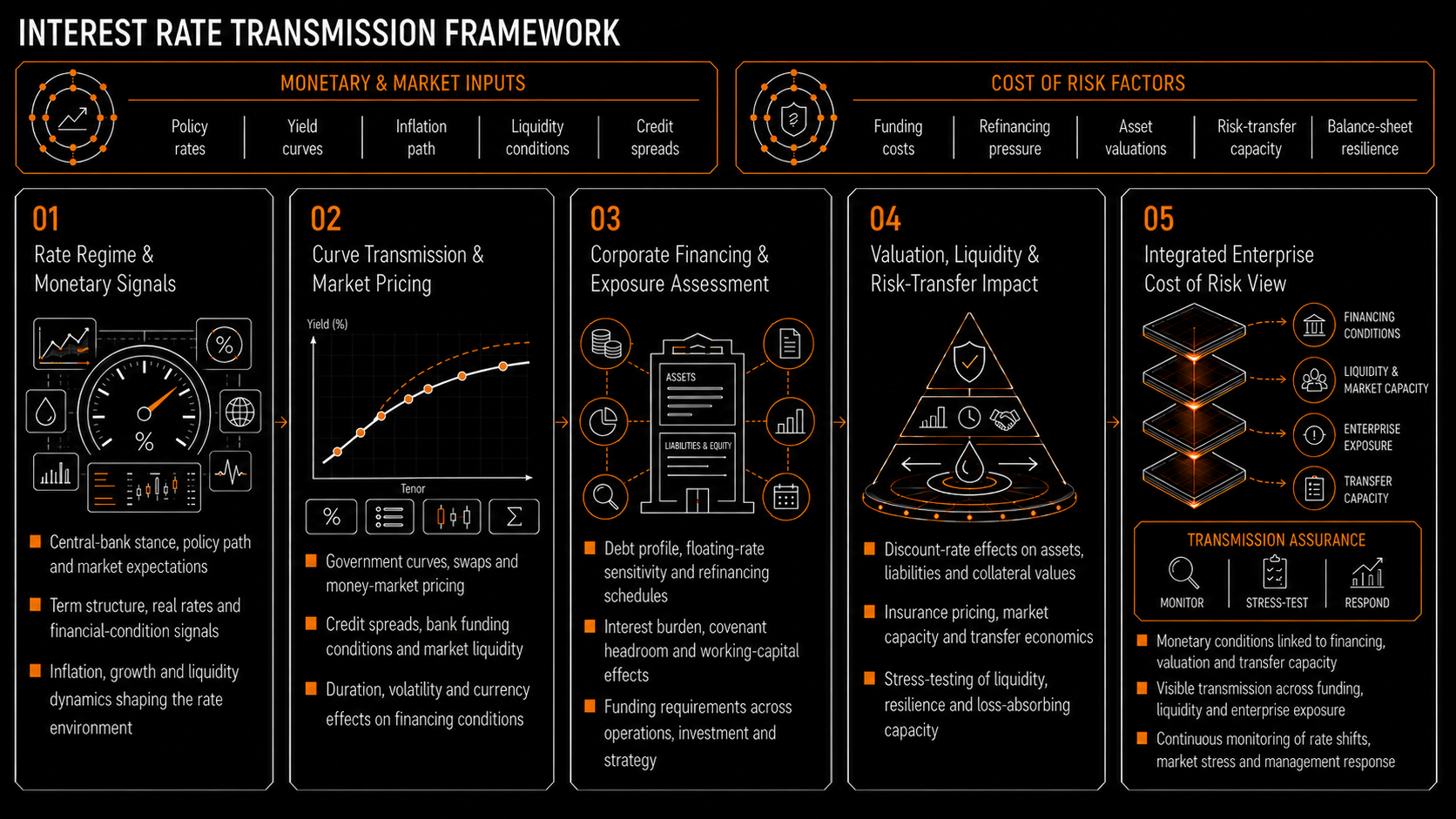
Interest rates change the cost of risk because they influence far more than the nominal price of borrowing. Monetary tightening or easing affects the shape of yield curves, the availability of liquidity, the pricing of sovereign and credit assets, the resilience of corporate balance sheets and the capacity of external markets to absorb risk. A company may therefore experience higher exposure not only through debt-service costs, but also through lower asset values, reduced refinancing flexibility, tighter market conditions and more expensive or constrained risk transfer. Effective macro analysis connects policy signals, market pricing, financing sensitivity, valuation effects, liquidity conditions and risk-transfer dynamics within one coherent transmission framework. This allows leadership to understand how shifts in the rate environment alter the economic cost of risk and to respond before monetary conditions become a strategic constraint.
© 2026 Coastlight Global Risk
COASTLIGHT EXECUTIVE BRIEF
Interest rates & the cost of risk

How policy rates, yield curves, liquidity conditions and refinancing pressure influence corporate funding, asset valuations and risk-transfer capacity across the enterprise.
monetary signals, yield-curve dynamics and liquidity conditions
funding sensitivity, refinancing exposure and balance-sheet transmission
valuation effects, transfer capacity and the enterprise cost of risk